
Are Dental Implants Worth It? A Guide for Colorado Patients
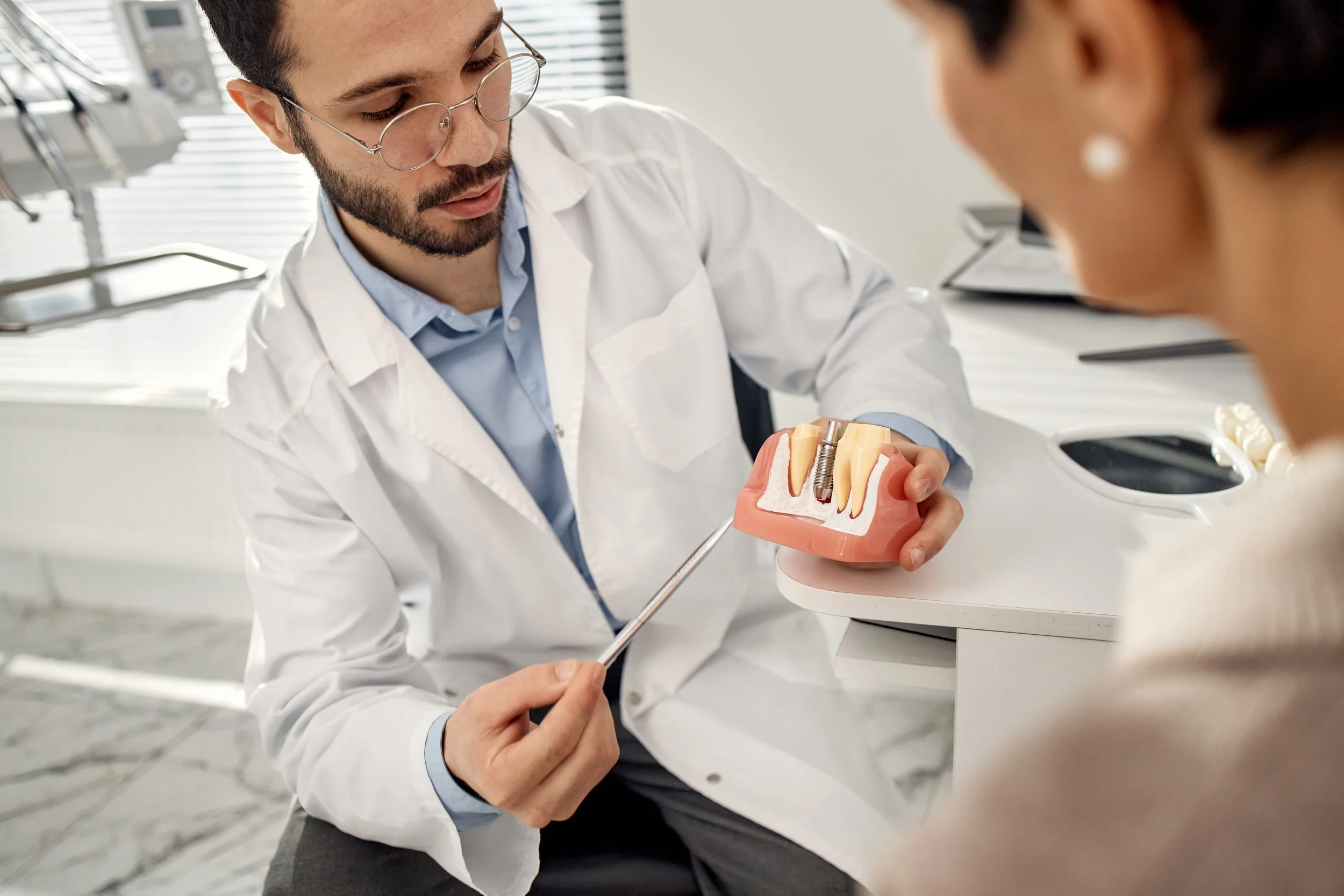
Photo: seventyfour74 via 123RF
Losing a tooth when you’re a child is all fun and games, especially when the Tooth Fairy paid a visit. But missing a tooth as an adult? That’s a whole different story.
Missing a tooth (or several teeth) as an adult is a common dental problem, though. And it’s one that obviously affects your smile and how confident you feel about your smile in everyday moments. But it can affect far more than that, too. It can change how you eat and drink, how you speak, and even your overall oral health.
If you’re exploring tooth replacement options, you’ve probably found yourself asking a very practical (and very valid) question: Are dental implants worth it?
For many patients, dental implants are considered one of the most effective and long-lasting solutions available. But they do require a greater investment of time and money than alternatives like bridges or dentures.
This guide is designed to help you understand what dental implants really are, how they compare to other options, and whether they make sense for your health, lifestyle, and long-term goals.
What Are Dental Implants? (in Plain English!)
When patients hear the phrase dental implant, they often imagine something bulky or mechanical. But actually, implants are surprisingly simple in concept, and very practical in everyday life.
Instead of just replacing the part of the tooth you see, a dental implant replaces the root as well. That’s what makes it different from bridges or dentures, and it’s also why many patients say it feels more “real” once everything is healed.
A dental implant starts with a small titanium post that’s placed into the jawbone. Titanium is used because the body accepts it well — something we often explain to patients who are understandably nervous about a foreign material in their mouth.
Over time, the bone grows around the implant and holds it in place. When patients hear this, they usually pause and say something like, “Wait. It actually becomes part of my bone?” And yes, essentially, it does — as weird as that might sound!
Once that healing phase is complete, the visible tooth, which is called the crown, is added on top. At that point, most patients stop thinking of it as an implant and start thinking of it as just… their tooth.
The Elements of a Dental Implant (and Why They Matter)
At Sanitas Family Dentistry, we find it helps patients understand implants a bit better by breaking them down — not because the process is complicated, but because knowing what’s happening reduces that sense of uncertainty and anxiety.
A dental implant has three main parts:
The implant post, which is the titanium “root” placed in the jawbone
The abutment, which connects the implant to the replacement tooth
The crown, which is the part you see when you smile
Patients are often most focused on the crown: how it will look, whether it will match, and whether people will notice it. In practice, that’s usually the easiest part. Today’s crowns are custom-made to blend in naturally, and once they’re in place, even patients tend to forget which tooth was replaced.
The real work happens beneath the surface, where the implant post bonds to the bone through a process called osseointegration. We won’t get overly scientific here, but this step is what gives implants their long-term strength and stability.
What the Dental Implant Process Is Actually Like
One of the biggest misconceptions we hear is that getting a dental implant is a single, intense procedure. Instead, it’s a series of steps intentionally spaced out over time.
Here’s how it typically unfolds:
1. Consultation: This is where we listen to your concerns and assess your oral health. Imaging and exams help determine whether implants are a good option, but the conversation matters just as much to address questions and concerns. Dental implants are generally suitable for most patients who have lost one or more teeth and have sufficient bone density to support the implant
2. Implant Placement: The implant itself is placed during a minimally invasive surgical procedure. We work with exceptional implant placement experts. And while many patients dread this step the most, they are often surprised by how manageable it is. A common comment we hear afterward is,“That was it?”
While there will be some mild swelling and soreness for a few days post-procedure, most patients experience hardly any disruption to their daily activities.
3. Post-Placement Healing: This is the part that patients actually find the hardest! And that’s because it requires a little bit of patience. Over the next few months, there is a waiting game before the permanent implant can be placed. During this time, the implant bonds with the jawbone. It’s not the most exciting phase, but it’s critical for long-term success.
4. Crown Placement: Once the implant is fully bonded and integrated to the jawbone, the custom restoration — a.k.a. the crown — can be placed. This is when patients feel like their smile is finally “complete” again.
Dental Implants Compared to Other Tooth Replacement Options
Dental implants, bridges, and dentures can all replace missing teeth, but they do it in very different ways — and those differences tend to matter more over time than patients initially expect.
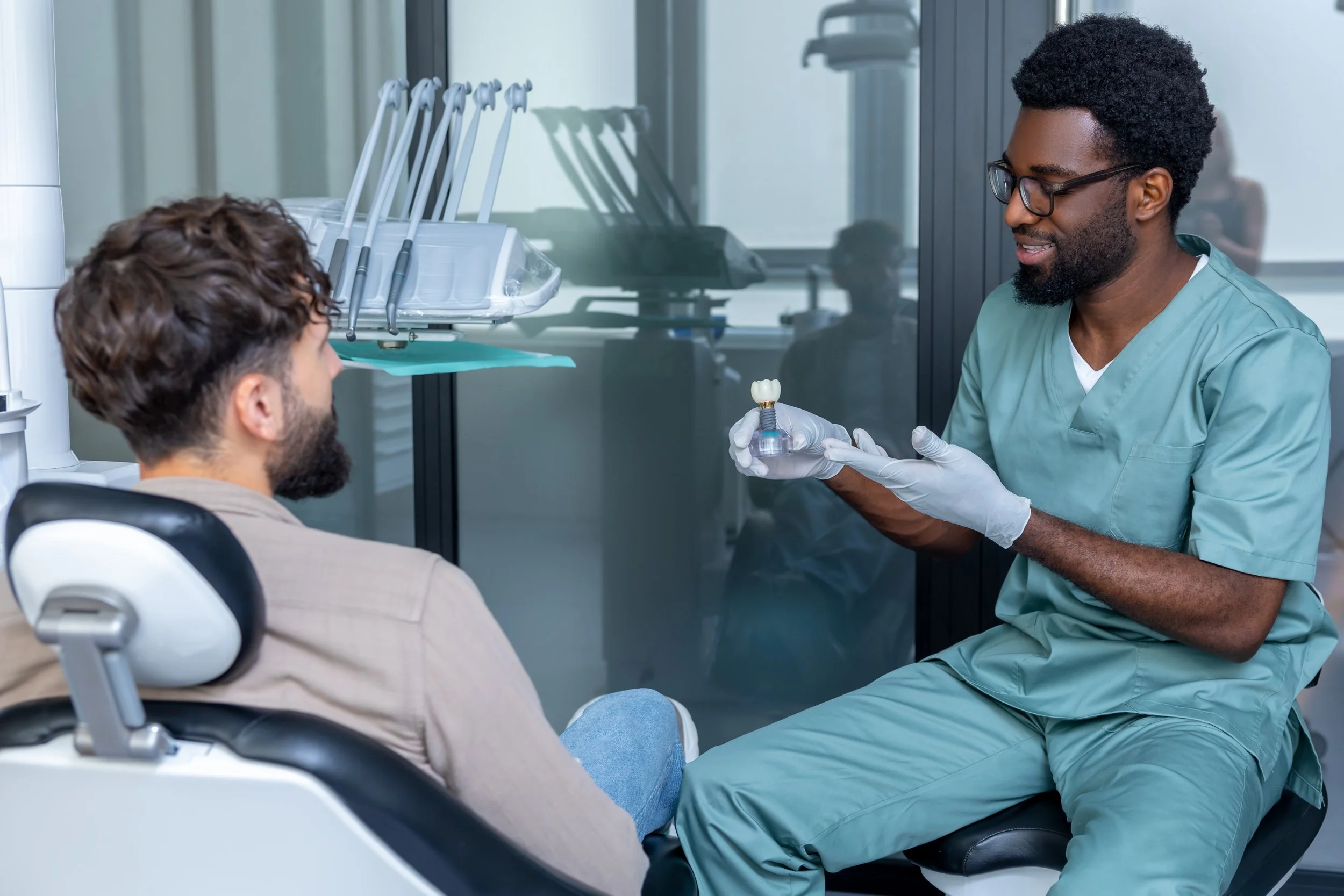
Photo: zinkevych via 123RF
Considerations for Dental Bridges
A dental bridge essentially replaces a missing tooth by attaching an artificial tooth to the teeth on either side of the gap. Bridges generally cost less upfront and can be completed more quickly than dental implants. That’s often a good thing for patients who want a quick fix or to avoid surgery.
But the downside is that bridges can potentially have a negative impact on healthy teeth. To place a bridge, the neighboring teeth typically need to be reshaped to support it.
Here’s a quick summary about dental bridges:
Lower initial cost
Faster overall treatment timeline
Often requires reshaping healthy adjacent teeth
Typically lasts 7 to 10 years before replacement
Considerations for Dentures
Dentures get a bad rap — but there’s a reason they’ve been commonly used for decades. They do work. Dentures can be partial or full, and they’re a reasonable option for some. Both partial or full dentures are generally more affordable and can be removed for cleaning. But dentures can also come with challenges that aren’t always anticipated.
For example, we often hear concerns about slipping, clicking, or needing adhesive to feel secure. Some patients also notice changes in their speech or the pronunciation of certain words. Others tend to avoid certain foods because chewing doesn’t feel as stable as it did before.
Here’s a quick summary about dentures:
Lower initial cost
Ease in cleaning, because they’re removable
May slip or feel unstable in the mouth
Could affect speech and eating
May accelerate bone loss in the jaw over time
May require replacements or repairs and adjustments over time, increasing the cost
Considerations for Dental Implants
While they’re more expensive, dental implants deliver a more permanent solution than both bridges and dentures. Because they’re secured in the jawbone, they don’t move or shift. Patients don’t need adhesives, and most say they stop thinking about their teeth altogether once the healing process is complete.
Here’s a quick summary about dental implants:
Higher initial investment
No adhesives required
Don’t alter neighboring teeth
Support jawbone health and preserve facial structure
Natural look and feel that provides improved comfort and confidence
Can last 20 years or more
Many patients who work with a dentist in Colorado for dental implants choose them because they offer many advantages in both the short and long term.
The Cost of Dental Implants in Colorado
Because the main drawback of dental implants is their cost, it’s not surprising that cost is one of the most common — and understandable — questions patients ask.
The cost of dental implants in Colorado can vary based on several factors, including how many teeth are being replaced, whether bone grafting or other preparatory procedures are needed, and the type of final restoration being placed. A single implant is very different from a full-arch solution, and materials and technology can also influence pricing.
At Sanitas Family Dentistry, we offer clear, transparent, and fair pricing to go along with a personalized treatment plan. The goal is to eliminate any surprises and help patients make informed decisions that feel right for them.
So… Are Dental Implants Worth It?
For many people, dental implants are worth it — but not because they’re the newest or most advanced option. They’re worth it because they solve multiple problems simultaneously.
Implants restore chewing strength so you can eat what you want, when you want, protect the jawbone, and eliminate the daily inconveniences of removable options. We often hear from patients who wish they had done implants years ago, especially after struggling with dentures or replacing a bridge multiple times.
That said, the concept of “worth” is highly personal. What makes sense for one patient may not make sense for another, and that’s okay.
Why Patients Choose Sanitas for Dental Implants
Whether you’re searching for dental implants in Colorado, researching options in Superior, Boulder, Louisville, or Erie, or simply Googling dental implants near me, this guide has helped you feel more informed (and more confident!) about your next steps.
And if you are looking for an option for dental implants near Superior, Boulder, Louisville, Lafayette, or Erie, Colorado, Sanitas Family Dentistry delivers the highest level of experience and care.
Our team always prioritizes a patient-first approach that focuses on both comfort and education. From the initial consultation to the final placement of the restoration, our team and dental implant specialist in Colorado guide patients every step of the way.
At Sanitas Family Dentistry, we are not only known for our modern techniques and state-of-the-art materials, but also for personalized evaluations and customized treatment plans. We provide clear, honest communication at every stage in a calm, supportive environment.